


Collection:
VHF/AIS Antenna

Choose your option

Choose your option


Choose your option


Choose your option

Choose your option


Navico NSPL-500 Antenna Splitter
Ref : 000-13612-001
Choose your option
En savoir plus
VHF/AIS Antennas: Capturing Essential Marine Information
The VHF/AIS antenna is a crucial component of your marine communication and safety system. At Skysat, drawing on our offshore racing experience, we know that a high-performance antenna means clear information and optimal range. Explore our selection of antennas, rigorously chosen for their robustness and efficiency, and find the one that meets your specific needs.
Choosing the Right VHF/AIS Antenna
Selecting a VHF/AIS antenna depends on several factors, including the type of navigation, boat size, and maritime environment. It is essential to consider the antenna's gain, polarization, and compatibility with your VHF radio and AIS transponder. A well-chosen antenna ensures clear communication and reliable AIS signal reception, enhancing navigation safety.
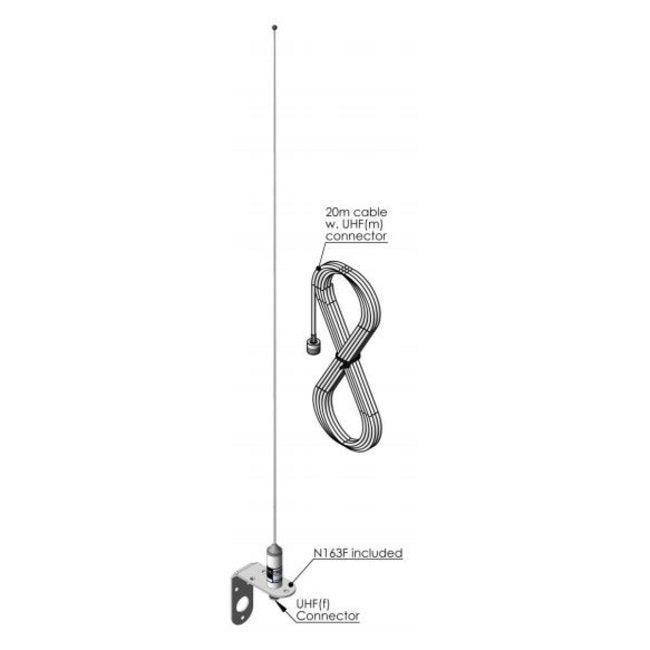
- Whip antennas: Standard solution suitable for most uses. Check impedance (typically 50 ohms).
- Short antennas: Ideal for small boats or cluttered environments. Compromise on range.
- VHF/AIS splitters: Allow sharing a single antenna between VHF and AIS. Be aware of induced signal loss.
- Coaxial cables: The choice of coaxial cable (RG-58, RG-213, etc.) affects signal loss. Opt for high-quality cable of appropriate length.
The Importance of Installation and Tuning
Installing and tuning your VHF/AIS antenna are critical steps to optimize performance. Poor positioning or faulty wiring can result in reduced range and poor reception. Follow the manufacturer's recommendations and ensure the antenna is properly grounded. An SWR (Standing Wave Ratio) test can help verify impedance matching and optimize transmission.
- Positioning: Install the antenna as high as possible and away from metal obstacles.
- Wiring: Use waterproof connectors and check for corrosion.
- Grounding: Ensure a good connection to the boat's ground to avoid interference.
- SWR Test: Verify impedance matching between the antenna and VHF/AIS radio.
GSM/4G Antennas: Staying Connected at Sea
To stay connected to the mobile network during coastal or offshore navigation, GSM/4G antennas amplify the signal and allow you to use mobile devices or onboard Wi-Fi routers. Antenna selection depends on the navigation area and available network quality. Ensure the antenna is compatible with the frequencies used by your carrier.
- Omnidirectional antennas: Capture signals from all directions, ideal for areas with weak signals.
- Directional antennas: Offer higher gain but require precise aiming toward the signal source.
- Marinized 4G routers: Combine a 4G antenna and Wi-Fi router, enabling a local network onboard.
- Low-loss cables: Essential to minimize signal loss between the antenna and router.
💡 Skysat Tip
Before choosing your VHF/AIS antenna, map your usual navigation areas and anticipate typical weather conditions. An oversized antenna can be an asset in low-coverage zones, but an antenna well-suited to your typical use will offer better overall reliability.


