


Collection:
Battery monitors


SmartShunt 500A/50mV
Ref : SHU500050100
Choose your option


BMV-712 BLACK Smart
Ref : BAM030712200
Choose your option


DC 200 A shunt with cable for DCM100
Ref : LEMHTA200-S
Choose your option

BATT INDIC INSIGHT GC2 3140R2448
Ref : BI-3140R-2448
Choose your option

Mastervolt BattMan Lite battery monitor
Ref : 70405060
Choose your option


Battery shunt 1,000 A, 50 mV
Ref : RSC-1000-50
Choose your option


Battery shunt 200 A, 50 mV
Ref : MS91587-2
Choose your option


DC 600 A Current Transducer with Cable for DCM10
Ref : LEMHTA600-S
Choose your option


DC 400 A current transducer with cable for DCM10
Ref : LEMHTA400-S
Choose your option


DC power monitor. (Battery monitor, solar panel monitor)
Ref : DCM100-01
Choose your option


Gen2 - Battery Monitor (cables not included)
Ref : A3680
Choose your option


Battery management panel with 16 single-pole circuit breakers
Ref : 800-MS3
Choose your option

Multimeter M2 DC with SoC
Ref : 1830-BSS
Choose your option


SmartShunt 1000A
Ref : SHU050210050
Choose your option


Smart Battery Sense long range (up to 10m)
Ref : SBS050150200
Choose your option


Smartshunt 500A IP65
Ref : SHU065150050
Choose your option
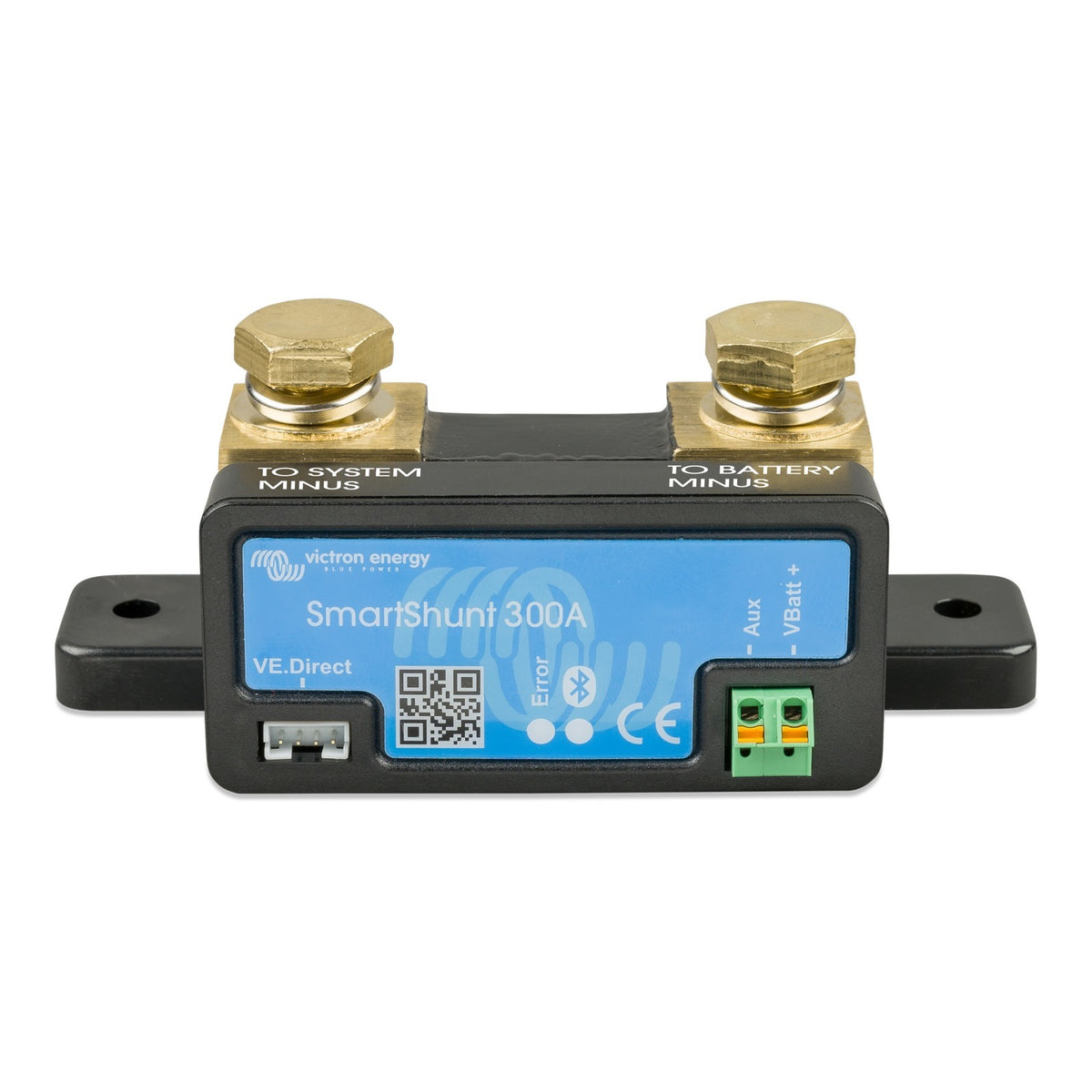

SmartShunt 300A
Ref : SHU050130050
Choose your option


SmartShunt 2000A
Ref : SHU050220050
Choose your option


BMV-712 Smart
Ref : BAM030712000
Choose your option


Battery monitor for NMEA 2000 network
Ref : ZDIGISSBM100
Choose your option


SmartShunt IP65 500A Battery Controller
Ref : SHU050150050
Choose your option


MasterShunt 500 CZone Battery Controller
Ref : 77020115
Choose your option


BattMan Pro. Battery Controller
Ref : 70405070
Choose your option
Learn more
Battery monitors: measuring actual bank autonomy on board
A battery monitor measures what a simple voltage reading does not: the current entering and leaving the bank, estimated state of charge, amp-hours consumed, battery voltage, and sometimes temperature. On a boat, it is the instrument that tells you whether you can spend a night at anchor, run an autopilot for several hours, or leave the fridge running without dropping the voltage too low.
This collection includes smart shunts, battery controllers, and dedicated displays for 12 V, 24 V, and 48 V banks. They complement the boat’s batteries, BMS, charge relays, and battery isolators: they measure and alert, but do not replace electrical protection devices.
Shunt, display, or sensor: three levels of monitoring
- Smart shunt: installed on the battery negative, it measures current accurately and calculates state of charge. It is the most reliable solution for monitoring a service bank.
- Dedicated display: useful when the crew needs to read autonomy without a phone, from the chart table or electrical panel.
- Voltage/temperature sensor: complements a Victron installation by sending voltage and temperature to compatible chargers or regulators, but does not measure current.
Main product families
- Victron SmartShunt 300 A, SmartShunt 500 A, SmartShunt 1000 A, and SmartShunt 2000 A: Bluetooth shunts without displays, readable via VictronConnect, sized according to the bank’s maximum current.
- Victron BMV-712 Smart and BMV-712 Black Smart: monitors with LCD display and 500 A shunt, ideal when permanent reading at the panel is needed.
- Blue Sea M2 DC with SoC: OLED display with 500 A shunt, designed to monitor a service bank and multiple battery voltages in a marine environment.
- Mastervolt MasterShunt 500 CZone and BattMan Pro: Mastervolt solutions for MasterBus, CZone/NMEA 2000, or standalone installations.
- Smart Battery Sense: wireless voltage/temperature sensor to improve Victron charging, without replacing a true current-measuring shunt.
How to choose the shunt rating
The shunt rating must cover the continuous current and peaks the bank can actually see. A small service bank without a large inverter can use a 300 A or 500 A shunt. A bank powering a powerful inverter, windlass, bow thruster, or heavy DC load must be sized higher, with consistent wiring and appropriate fuses.
- 300 to 500 A: standard service bank, electronics, lighting, fridge, pump, small inverters.
- 1000 A: larger bank, substantial charger-inverter, lithium architecture, or heavy DC consumers.
- 2000 A: large architectures where peak currents and main distribution require a higher margin.
What the monitor does not do
- It does not automatically disconnect a faulty lithium battery: that is the role of the BMS and isolation devices.
- It does not replace a fuse or main battery isolator.
- It does not correct a misconfigured charge: battery parameters must match chemistry, capacity, and charging sources.
- It only provides reliable autonomy if battery capacity, tail current, charge efficiency, and synchronization are correctly set.
Common mistakes
- Relying solely on battery voltage to estimate autonomy, especially with LiFePO4 where the voltage curve remains flat for a long time.
- Installing the shunt on a partial return path: all service bank current must pass through the shunt, otherwise state-of-charge calculations become inaccurate.
- Ignoring permanent loads: routers, AIS, monitoring, relays, alarms, or NMEA 2000 can slowly drain a bank at anchor.
- Never resynchronizing the monitor after changing capacity or replacing batteries.
- Choosing a visible display but ignoring shunt accessibility, fuse placement, and measurement connections.
Skysat advice
On a cruising sailboat or a boat with extensive electronics, the battery monitor is one of the first instruments to install properly. It turns a vague sense of autonomy into usable data: instantaneous current, consumption per night, actual available capacity, alternator efficiency, and solar yield.
For a lithium bank or complex architecture, we always separate functions: the BMS protects, the shunt measures, the battery isolator isolates, and the fuse protects the cable. A good monitor makes the system understandable to the crew and simplifies diagnosis before a failure becomes an emergency.


