


Collection:
BMS batteries
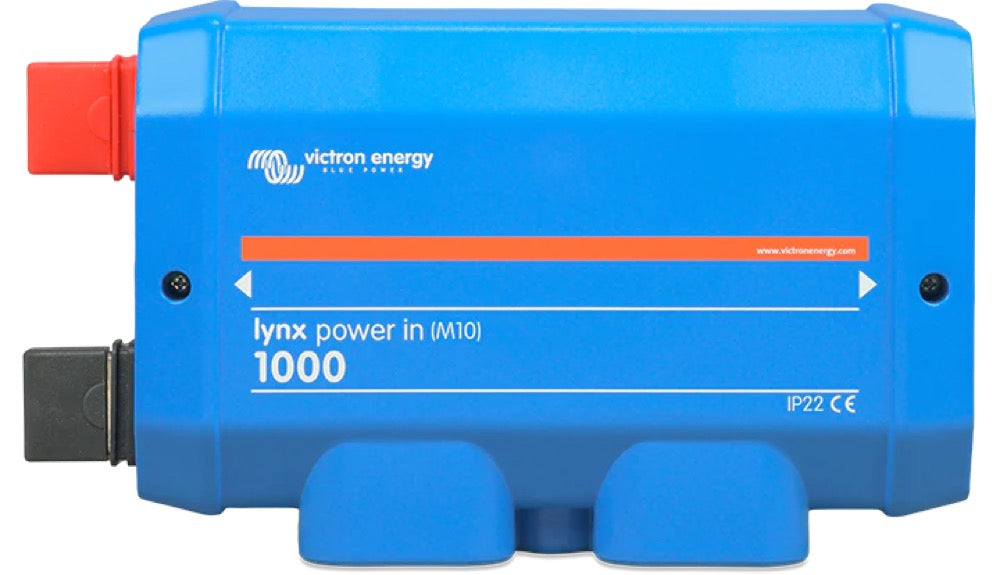
Lynx Power In (M10)
Ref : LYN020102010
Choose your option


Lynx Shunt VE.Can 1000A
Ref : LYN040102100
Choose your option

Lynx distributor 1000A, M10
Ref : LYN060102010
Choose your option


Samlex
Automatic 12/24V battery monitor
Ref : CB823
Choose your option


VE.Bus BMS
Ref : BMS300200000
Choose your option

Lynx Smart BMS 500 NG (M10)
Ref : LYN034160310
Choose your option


Choose your option

Battery Balancer
Ref : BBA000100100
Choose your option


Lynx Shunt VE.Can 1000A (M10)
Ref : LYN040102110
Choose your option


Choose your option


smallBMS NG
Ref : BMS400100300
Choose your option

Lynx Smart BMS 500 (M8)
Ref : LYN034160200
Choose your option

Lynx 1000 DC M8 distribution block
Ref : LYN060102000
Choose your option


Smart BMS 12/200
Ref : BMS210055000
Choose your option

Lynx Class-T Power In (M10)
Ref : LYN060404010
Choose your option


Lynx Smart BMS 1000 NG (M10)
Ref : LYN034170310
Choose your option


Choose your option


Smart BMS CL 12-100
Ref : BMS110022000
Choose your option


SolidSwitch 104
Ref : BMS800200104
Choose your option
Learn more
BMS batteries: protecting and managing a marine lithium bank
A BMS (Battery Management System) is the safety layer of a lithium battery bank. It monitors cell voltages, temperatures, and current limits, then allows or cuts charge and discharge when the battery leaves its normal operating range.
On a boat, the BMS should not be seen as an optional accessory. It protects batteries from faults that are expensive at sea: overcharging, deep discharge, charging at low temperature, cell imbalance, overcurrent, or poorly controlled alternator. This collection includes Victron BMS units, Lynx modules, and distribution accessories required for a coherent lithium architecture.
What does a BMS do in a marine installation?
- Authorize or cut charging: the BMS sends a signal to chargers, MPPTs, battery chargers/converters, or charge relays when the battery can accept current.
- Authorize or cut loads: it protects the bank from deep discharge by controlling a relay, a load disconnect output, or a main contactor.
- Monitor cells: a cell voltage that is too low, too high, or an out-of-range temperature must trigger an action, not just an alarm.
- Supervise the system: in advanced architectures, the BMS reports the bank’s status to VictronConnect, a GX device, the VRM portal, or a VE.Can network.
Choosing based on battery and architecture
The first criterion is not the BMS price, but the battery series and the expected integration level. Victron Lithium Smart, Lithium NG batteries, Lynx systems, and 12/24/48 V banks do not always use the same interfaces or the same cutoff functions.
- smallBMS V2 and VE.Bus BMS: simple Victron Lithium Smart architectures, with charge/discharge outputs to control compatible equipment.
- BMS NG and smallBMS NG: generation designed for Victron Lithium NG batteries, with integration tailored to the new 12.8 V, 25.6 V, and 51.2 V variants.
- Smart BMS 12/200 and Smart BMS CL 12-100: 12 V solutions with alternator charge management and Bluetooth (depending on model), useful for compact refits.
- Lynx Smart BMS 500, Lynx Smart BMS 500 NG and Lynx Smart BMS 1000 NG: heavy-duty architectures with main contactor, precharge, and VE.Can/GX integration.
Lynx modules: distribution, shunt, and protection
A lithium installation does not end with the BMS enclosure. Lynx modules structure the DC distribution around the battery bank: Lynx Power In for battery input, Lynx Distributor for protected distribution, Lynx Shunt VE.Can for measurement, and Lynx Class-T Power In when Class-T fuse protection is required.
These modules do not replace proper sizing: continuous current, peak current, fuse type, M8/M10 stud size, and cable cross-section must match the battery bank, inverter, and onboard loads.
What a BMS does not replace
- A properly configured battery monitor: the BMS protects; the monitor measures and helps assess range.
- Properly sized fuses near energy sources: the BMS is not a universal short-circuit protection device.
- Battery isolators for manual shutdown, maintenance, and bank isolation.
- Proper alternator management: depending on the architecture, a DC/DC charger, external regulator, or current limiting may be required.
Common mistakes
- Installing a lithium battery with a BMS incompatible with the battery series.
- Abruptly cutting the alternator without a shedding path or protection strategy.
- Confusing alarm output with a power cutoff device.
- Ignoring temperature thresholds: many lithium batteries must not be charged below 0 °C without heating or adapted logic.
- Selecting a Lynx module or shunt based solely on nominal current, without checking fuse type, connections, and available space.
Skysat advice
Before choosing a BMS, identify the exact battery, system voltage, charging sources, and loads that must be cut in case of a fault. The correct diagram specifies which device receives the allow to charge signal, which receives the allow to discharge signal, which device cuts high current, and how the alternator is protected if the BMS rejects charging.
For a small 12 V bank, a simple solution may suffice. For a large-capacity lithium bank, a powerful inverter, or a 24/48 V architecture, the system must be designed as a whole: BMS, Lynx, fuses, isolators, shunt, chargers, and wiring. It is this consistency that makes the installation reliable, not the BMS alone.


